
Operations

.png?width=48&height=48&name=Conrad%20Face%201%20(1).png)
It’s not a leadership problem. It’s a systems problem.
Most restaurants don’t fail when they try to scale. They stall.
Specifically, they stall between Location 2 and Location 4, when the business becomes too complex to run on instinct, but still too small to support a full executive team.
This is one of the most common and least discussed ceilings in restaurant growth.
Every shift. Every decision. Every problem solved in real time.
The owner is the system.
Time gets split. The phone never stops. But revenue is up, so the chaos feels justified.
Until it doesn’t.
A trusted manager starts making decisions the owner wouldn’t make. Food cost creeps up at one location but not the other, with no clear explanation. Late-night texts arrive about broken equipment while staffing issues unfold across town.
The owner’s role quietly shifts from building the business to absorbing operational friction.
At roughly $1–2M per unit, operators are caught in the middle.
They can’t afford a CFO, COO, or analytics team. But they also can’t be everywhere at once. Many two-unit operators doing $3–4M annually believe a third location will unlock economies of scale.
In reality, it unlocks complexity that compounds faster than revenue.
This is the stage most operators aren’t prepared for.
After observing hundreds of 2–4 unit operations across the Northeast, the pattern is remarkably consistent.
The owner is exhausted. The team is uncertain. And everyone is working harder for less leverage.

Restaurants cannot be managed at 3–4 locations the same way they were managed at 1–2.
More effort doesn’t solve this phase. More meetings don’t solve it. Hiring one more “rockstar” doesn’t solve it. What breaks is not commitment or culture. What breaks is shared visibility and aligned decision-making.
At this stage, the business no longer has a single operating brain.
.png?width=150&height=150&name=Conrad%20Face%201%20(1).png) Why data intelligence becomes non-optional at this stage
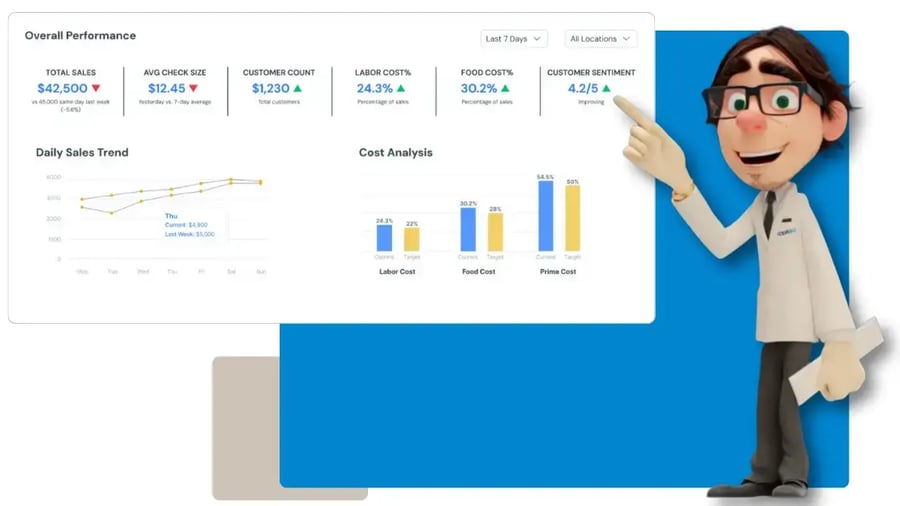
Why data intelligence becomes non-optional at this stageThis is the moment when growing operators need more than reports and dashboards.
.png?width=300&height=300&name=CONVX%20Hero%202%20(3).png) They need a restaurant data intelligence platform that can:
They need a restaurant data intelligence platform that can:
When intelligence is centralized, decisions become consistent, as does the culture.
When insight is timely, intervention becomes preventative. This is how restaurants begin to scale systems before headcount. Not to replace operators, but to give them the same clarity the owner once had standing in the building.
The growth ceiling is rarely capital or opportunity. It is the refusal to acknowledge that what worked at two locations will not work at four.
Breaking through requires:
- Systems that function without constant owner intervention
- Leaders empowered by the same information, not just instincts
- The discipline to delay additional locations until existing ones run predictably
The restaurants that scale are not tougher or luckier. They simply stop trying to be everywhere at once.
How many hours were spent last week managing fires that should have been visible sooner?
That gap between reaction and insight is where modern restaurant data intelligence platforms earn their keep.
 If you’re running multiple locations, you shouldn’t be guessing.
Schedule a demo to see how real-time data intelligence helps operators spot issues earlier, align teams faster, and scale with confidence.